This document is to provide campus users with a list of frequently asked questions regarding LCD.
HR 9.0 vs CHRS
What is the difference between the 9.0 LCD process and the CHRS LCD process?
The biggest difference is the first step. Instead of campuses loading the SCO Pay Tape, the SCO Pay Tape Load will be handled centrally by System Wide Human Resources (SWHR).
Another change is the Expenditure adjustments will now have a preliminary view flag.
Processing
In CHRS, where can I go to see the status of my campus’s LCD processing?
Go to the CSU LCD Processing Flags page and enter your campus company and Pay Tape Period.
Navigation: Menu > Payroll for North America > CUS Labor Cost Distribution > CSU LCD Process > CSU LCD Processing Flags
What is the timeline for CHRS Operations to load the SCO Pay Tape?
SWHR is aware of the urgency of this process and will do their best to process as soon as the file is available.
How are campuses notified once CHRS Operations has loaded the SCO Pay Tape?
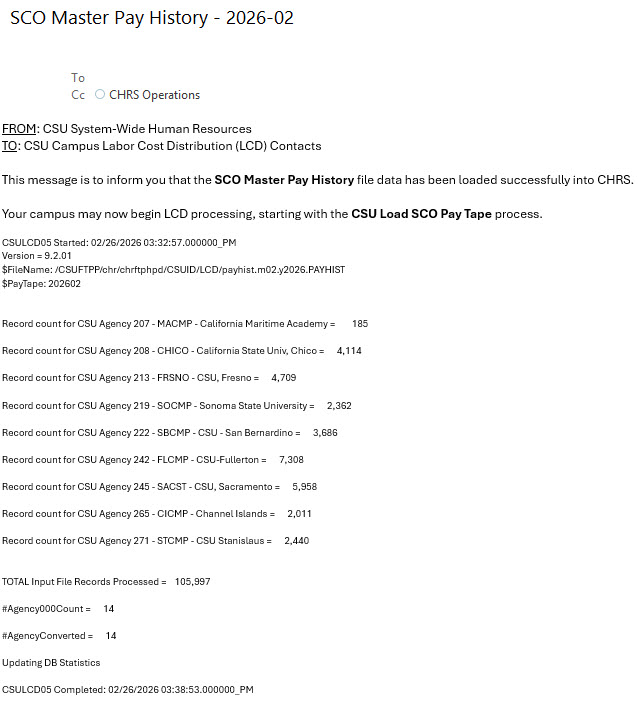
The Campus LCD Contact will receive an email notifying them that the paytape has been loaded.
Where is a list of LCD Contacts located?
The list of LCD contacts is available on the CHRS Production SharePoint site.
Is the CSU Check Creation Warning Messages new to CHRS?
The CSU Check Creation Warning Messages do exist currently in production and will remain the same in CHRS.
How and when does the CSU_LCD_JOB_DTL table get populated?
The CSU_LCD_JOB_DTL record is dynamically created every month by the CSULCD15 App Engine program (the first half of the CSU Create Paycheck Data Job, prior to CSULCD20).
Will the CO have a centralized process for ESP going forward? Or is this something we will have in the future?
Currently there are no plans to change the ESP process.
What is the Account Code Level Hierarchy used in the LCD Distribution Process?
The table below shows the order in which the LCD Distribution process tries to find the correct combo code to distribute funds to. If no Combo Code is assigned on the Paycheck Creation Error Online Page, the LCD Distribution program (CSULCD40) tries Account Code Levels 2-9 from the table below. The CSU Distribution program will take the first Combo Code it can find, and once a Combo Code is found, it will not continue with the subsequent steps. If a Combo Code is still not assigned in the CSU Distribution program, it should be assigned manually using the CSU Distribution Errors online page.
| ACCT_CD_LVL | Description |
| 1 | Paycheck Creation Error Online Page (before CSULCD40) |
| 2 | Time and Labor |
| 3 | Additional Pay (Immediate Pay or PIP transactions) |
| 4 | Job Earnings Distribution Page (Only checked if earnings code = REG) |
| 5 | Job Data Page |
| 6 | Department Budget Table – Appointment |
| 7 | Department Budget Table – Position |
| 8 | Department Budget Table – Position Pool |
| 9 | Department Budget Table – Department |
| 10 | Distribution Error Online Page (after CSULCD40) |
| 11 | Distribution Override Online Page (after CSULCD40) |
For Additional Pay and Time & Labor entries, where an account code override exists, when and where does the LCD process look for account code? Does the entry have to exist on a specific table, other than ps_tl_payable_time, ps_tl_rptd_time, or ps_addl_pay_data?
Time & Labor entries come in via the TL_PAYABLE_TIME record. The campus then must run the CSU TL Earnings Distribution process (CSUTL09A.SQR) for that data to get populated into the CSU_TL_ERN_DIST record. From there, Paycheck Create program (CSULCD20.SQR) picks up the Combo Code from the CSU_TL_ERN_DIST record. For Additional Pay, that gets entered on the Additional Pay page into the ADDL_PAY_DATA record, which should also get picked up in the Paycheck Create program (CSULCD20.SQR).
Account Mapping
Who is responsible for setting up different Job Functions in CHRS?
Campuses are responsible for setting up and maintaining.
Job Aid: CSU Acct Mapping- Job Function
Why does Job Function need to be configured in CHRS?
The CSU Acct Mapping- Job Function serves as a bridge between CHRS and CFS, since the finance system recognizes only the Account value and not Job Codes itself. The Job Function serves as a grouping mechanism for job codes. If this configuration is not completed, an error can occur during the LCD process.
Who is responsible for setting up different CSU Acct Mapping - Earnings Cd in CHRS?
Campuses are responsible for setting up and maintaining.
Job Aid: CSU Acct Mapping - Earnings Cd
Why does CSU Acct Mapping - Earnings Cd need to be configured in CHRS?
The CSU Account Mapping – Earnings Code serves as a bridge between CHRS and CFS, because the finance system recognizes only the Account value and not the Earnings Code itself. If this configuration is not completed, an error may occur during the LCD process.
Who is responsible for setting up different CSU Acct Mapping - Tax Class in CHRS?
Campuses are responsible for setting up and maintaining.
Job Aid: CSU Acct Mapping - Tax Class
Why does CSU Acct Mapping - Tax Class need to be configured in CHRS?
CSU Acct Mapping - Tax Class rarely requires modification but can occur based on changes within Benefits. If this configuration is not completed, an error can occur during the LCD process.
Who is responsible for setting up different CSU Acct Mapping - Deduction in CHRS?
Campuses are responsible for setting up and maintaining.
Job Aid: CSU Acct Mapping - Deduction
Why doesCSU Acct Mapping - Deduction need to be configured in CHRS?
The CSU Acct Mapping - Deduction rarely requires modification but can occur based on changes within Benefits. If this configuration is not completed, an error can occur during the LCD process.
Adjustments
What are Adjustments for?
CSU Expenditure Adjustments when you need to create an after-the-fact journal correction in CHRS to keep CHRS and CFS in sync after LCD has already produced (and typically exported) the payroll accounting lines.
Job Aid: CSU Expense Adjust
What is the maximum number of adjustments that can be processed in a single day?
The process is limited to 999 adjustments per day, as it cannot accommodate additional entries.
Adjustments use a sequence number (SEQNUM) keyed by date, sequence number, and line number. Although SEQNUM is defined as a 3-digit field, the LCD process can assign values greater than 999. When sent to CFS, any SEQNUM over 999 is rejected, effectively limiting the process to 999 adjustment runs per day.
SEQNUM represents the adjustment run, with multiple entries possible within a single run, while LINE_NBR identifies each accounting line within that run (e.g., one run may have SEQNUM = 1 with LINE_NBRs 1–24).
Can an adjustment be made for multiple charge periods at once?
Yes, a new process was created to expense adjustments for multiple charge periods with one action.
Combo Codes
What is a Combo Code?
A Combo Code (Combination Code) is a PeopleSoft shortcut value that represents a predefined set of ChartFields used to record payroll expenses and related accounting activity.
Instead of storing multiple ChartField values on every payroll row, CSU Labor Cost Distribution (LCD) stores one Combo Code, which expands to the full accounting string during processing.
What does a Combo Code represent?
A single Combo Code maps to one unique combination of ChartFields, typically including:
- Account
- Department
- Fund
- Program
- Class
- Project/Grant (if applicable)
- Other campus-required ChartFields
What is the order of a Combo Code?
The standardized order is: DEPTID – FUND – ACCOUNT – CLASS – Program – PROJECT/GRANT
How are Combo Codes created in CHRS?
Campuses are responsible for setting up their Combo Codes using the Combo Code Add process.
How are Combo Codes updated in CHRS?
Using the Combo Code Update process in CHRS allows you to modify both the long and short descriptions.
How are Combo Codes deleted in CHRS?
The Combo Code Delete process allows campuses to remove one or more invalid combo codes from CHRS without needing backend SQL.
Is there a recommendation on how often should the Combo Code Sync be ran?
It is recommended that the Combo Code Sync process be ran each month right before you begin monthly LCD processing
Why is a standardized Combo Code format necessary in CHRS?
To provide campuses with the highly requested Mass Combo Code Add functionality, standardization of the Combo Code format was necessary. This requirement was discussed during multiple meetings, with minimal concerns or objections raised. As CHRS continues to expand with additional implementing campuses, processing times for critical functions—such as Combo Code Sync, the GL Interface, and Time Administration—will likely increase. A standardized format improves efficiency by providing programs with a consistent structure upfront, reducing the need to search for and interpret varying formats. It also strengthens troubleshooting by making Combo Codes easier to identify, compare, and validate across campuses. Although campuses could create Combo Codes in any order in HR 9.0, the CHRS shared environment requires a consistent enterprise-wide format to support scalability, improve system performance, and simplify ongoing maintenance.
How could campuses distinguish between similar Combo Codes?
Campuses should use the description field to distinguish between similar Combo Codes because the standardized code may truncate longer ChartField combinations. For example, a Combo Code containing Department D00700, Fund A0575, Account 601030, Class AG001, and Program 13102 would display as D00700A0575601030AG001131 and could use the description President-AG001-13102. A similar Combo Code without Program 13102 would display as D00700A0575601030AG001 and use the description President-AG001. The descriptions clearly identify the difference between the two codes.
What is the standard length of a Combo Code?
25 Characters
Department Budget Table
What is the purpose of the Department Budget Table?
The Department Budget Table is used to budget salary expenses by department, position pool, job code, position number, appointment, or any combination. Set budget caps at each level—for earnings, deductions, taxes, or total expenditures—to ensure lower-level budgets don't exceed higher-level limits. These caps are not used for encumbrance or actuals processing; only budget amounts are used for that purpose.
Who is responsible for setting up and updating the Department Budget Table?
Campuses are responsible for setting up and updating their campus' Department Budget Table.
What is the hierarchy for the Department Budget Table?
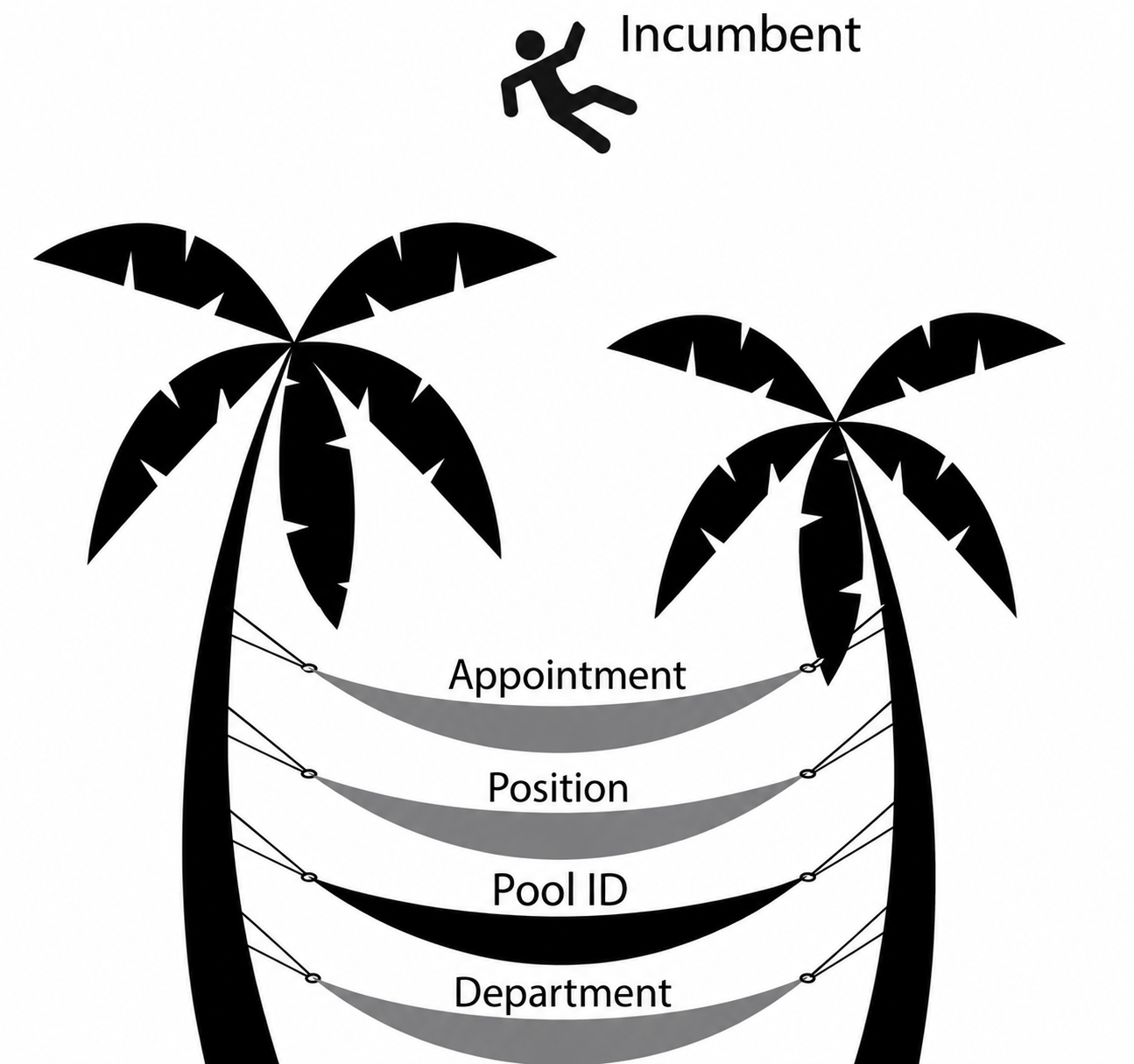
The Department Budget Table (DBT) is hierarchical, with Appointment > Position > Pool ID > Department.
Deduction Codes
What is the purpose of the Deduction Code?
The deduction code identifies the specific deduction on a payroll transaction and is used to match it to the Deduction Table so LCD/check creation can process it correctly (including effective-dated validation). It also drives how the deduction is treated for tax/classification and ensures the required accounting setup (e.g., liability/account mapping) is available for distribution and journaling.
Where can I access a list of Deduction Codes in CHRS?
A list of Deduction Codes can be found in the Data Dictionary List by Alpha Order.
Who is responsible for setting up and updating Deduction Codes?
CHRS Operations will be responsible for Deduction Codes, but campuses can request for a value to be added.
What should I do if I need a new Deduction Code added?
Why are campuses not given access to setup or update Deduction Codes in CHRS?
Deduction Codes are NOT defined by the campus and therefore, any deduction codes added or updated in CHRS affects ALL campuses.
Position
Can we use pool positions?
Yes, the functionality in CHRS will be the same as it is in 9.0.
Where can I find more information about Position Management?
For CHRS, Position Management is housed under Workforce Administration.
Who is responsible for setting up and updating the Position Pool Table?
Campuses are responsible for setting up and updating the Position Pool Table.
Suspense Code
What is the purpose of the Suspense Code?
In CSU Labor Cost Distribution (LCD), the Suspense Combination Code exists only because PeopleSoft requires it on the Department Budget Table (DBT). It is not used by CSU LCD to distribute costs, nor does any custom CSU process ever post expenses to it. It is simply a mandatory placeholder to satisfy delivered PeopleSoft functionality.
Can campuses have the same Suspense Code?
No. Campuses may NOT share the same Suspense combo code value.
Even though the Suspense code is only a placeholder and not used by CSU LCD for posting, combo codes themselves must be unique within a shared SetID, which is how CSU campuses are configured.
Reporting
If I want to get the “Chartfield” or “cost accounting code” related to a student’s payment, (from a given list of student employee), what table would I find this information?
CSU_LABOR_DIST, which is an LCD Reporting Table.
Is the CSU Combo Code Validation report obsolete in CHRS?
No.
Does CHRS App Dev support campus-created LCD queries?
No.
Are you also able to confirm whether CFS Data Warehouse reports are impacted by the LCD Table Refresh and Publish Data to FIN?
Yes, CFS Data Warehouse reports are impacted by the LCD Table Refresh and Publish Data to FIN.
The CSU_LABOR_DIST record is the primary LCD reporting record that gets sent to CFS and Finance Data Warehouse.
If my campus has custom reports in 9.0 for LCD, will those be in CHRS?
Campuses can recreate their custom reports as queries in CHRS or in CHRS Reporting.
What reports will be available in CHRS?
The following reports will be available:
- CSU Combo Code Validation
- CSU Combo Edit Validation
- CSU Pay Recon Summary (Clear)
- CSU Pay Recon Summary (Fund)
- CSU Paycheck Distribution Detail
- CSU Paytape Balance (Agency)
- CSU Paytape Balance (Clear)
- CSU Paytape Detail Balance
- CSU Pre Check Audit Report
Will LCD be delivering any queries in CHRS?
Yes, the LCD Delivered Queries for CHRS provides a standard set of reporting options, campuses also have the ability to create their own private queries to meet specific business needs.
Integration
When the ChartField is modified in CFS, will it still go through integration to update CHRS and CS?
Yes.
When the Journal ID (HR_ACCTG_LINE.JOURNAL_ID), Journal Date (HR_ACCTG_LINE.JOURNAL_DATE), Journal Line (HR_ACCTG_LINE.JOURNAL_LINE) are updated or Journal Generated in CFS, will it still go through integration to update CHRS?
Yes.
When the Accounting Period (HR_ACCTG_LINE.ACCOUNTING_PERIOD) and Fiscal Year Line (HR_ACCTG_LINE.FISCAL_YEAR) are updated in CFS, will it still go through integration to update CHRS?
Yes.
End of Article